Dairy Milk Comparison: Whole, Skim, and Everything Between
Every carton of dairy milk that arrives at the steam wand carries its own particular weave of proteins, fats, and sugars — and the ratio of those three components determines almost everything about the foam you can build from it. Understanding how different fat percentages change the texture, stability, and pourability of steamed milk is one of the most direct ways to improve latte art, because the milk you choose sets the upper boundary of what your technique can achieve.
Fat Content: The Central Thread
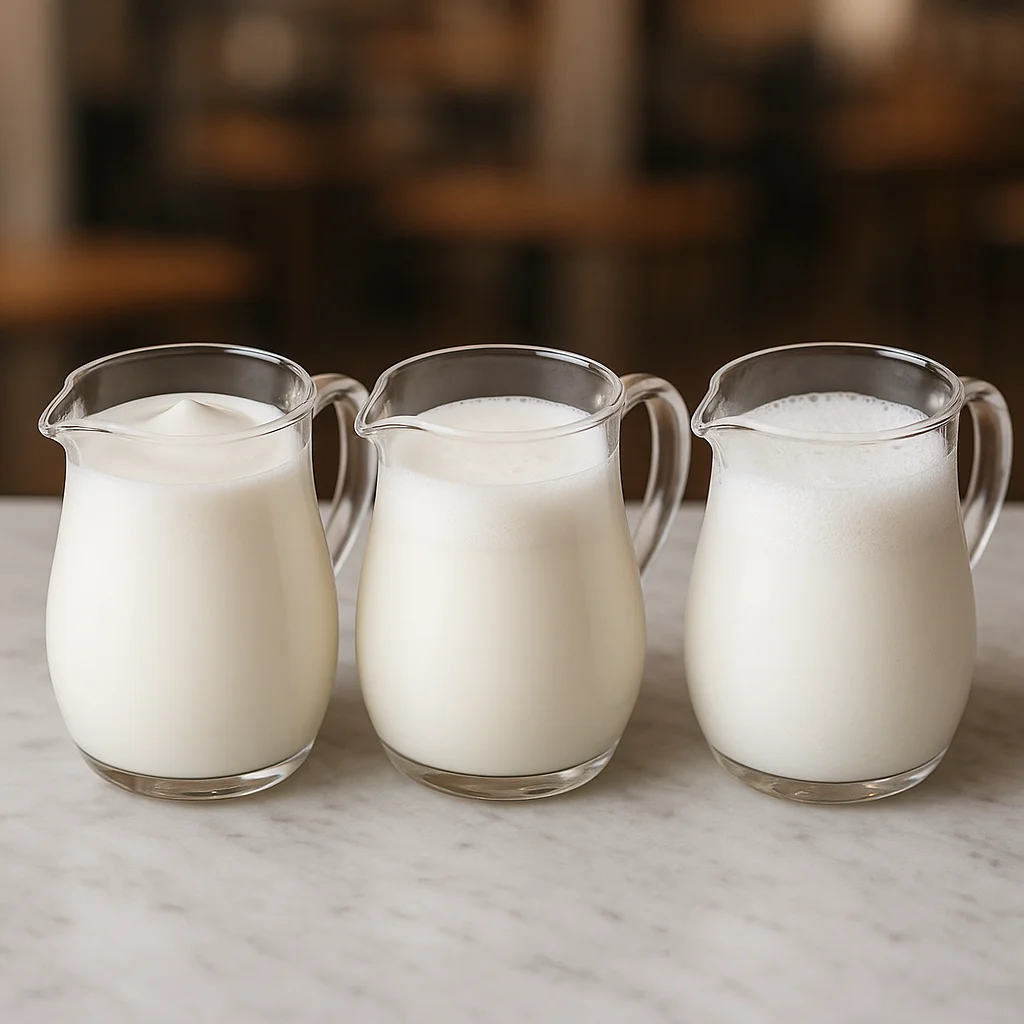
Fat is the component most people think about first, and for good reason. It acts as both a lubricant and a structural element within the foam matrix. In whole milk — typically around 3.25% fat by weight — fat globules intersperse themselves between the protein-stabilised bubble walls, lending the finished microfoam a dense, velvety body that flows with a slow, almost paint-like consistency. This is the quality that makes whole milk the default recommendation for latte art: it pours with enough weight and cohesion to hold fine detail in a rosetta’s spine or the symmetry of a tulip stack.
As fat content drops, the character of the foam shifts in predictable ways. Reduced-fat milk (2%) steams into foam that is slightly thinner in body but still capable of good microfoam when technique is careful. Skim milk (0–0.5% fat), by contrast, produces foam that is voluminous and stiff — almost meringue-like — because the protein network, freed from the softening influence of fat, builds rigid bubble walls with ease. The trouble is that this stiffness resists the fluid integration needed for pouring clean art. Skim foam tends to sit on top of espresso rather than weaving into it, and its bubbles, though numerous, are less uniform in size and quicker to drain.
Protein’s Quiet Dominance
While fat gets the attention, protein is the load-bearing structure. The caseins and whey proteins in dairy milk — explored in depth on the Milk Chemistry page — are what actually stabilise each bubble. When milk is heated, whey proteins (particularly β-lactoglobulin) unfold and migrate to the air-water interface, forming an elastic skin around every pocket of air the steam wand introduces. Whole milk contains roughly 3.2–3.4 g of protein per 100 mL, and this figure stays remarkably consistent across fat percentages, which is why even skim milk foams so readily.
The practical consequence is that protein gives you foam, but fat gives you pourability. A milk with high protein and moderate fat — whole milk, essentially — strikes the balance that most baristas find ideal: enough structural protein to create tight, glossy microfoam, and enough fat to keep that foam fluid and integrated with the liquid beneath it. When you encounter ultra-filtered or protein-fortified milks (sometimes labelled as having 5 g or more of protein per 100 mL), the foam can become almost too stable, resisting the gentle collapse that latte art pouring depends on.
Cream-Enriched and Half-and-Half: The Upper Extreme
Moving in the opposite direction — toward heavy cream or half-and-half — reveals fat’s diminishing returns. Above roughly 10% fat, the abundance of fat globules begins to destabilise the protein film around bubbles, and the foam becomes thin, greasy, and quick to collapse. Half-and-half (typically 10–12% fat) can produce a pleasant, rich texture for drinking, but it resists the kind of tight microfoam needed for defined latte art. Heavy cream, at 36% fat or above, barely foams at all under a steam wand; the fat simply overwhelms the protein’s capacity to hold air.
The grain of the foam, in other words, is finest and most workable in a relatively narrow band of fat content — somewhere between 2% and 4% — where protein and fat cooperate rather than competing.
Finding the Right Milk for Your Work
The choice between dairy milks is not purely about fat percentage; freshness, pasteurisation method, and even the breed of cattle influence protein behaviour under steam, as the Physics of Foam page discusses in more detail. But fat content remains the single most accessible variable to adjust. For those finding their foam too stiff and dry, moving up in fat content is the most reliable correction; for those whose foam feels loose and disappears into the cup, the issue may lie elsewhere — the Troubleshooting page is a good next step. What matters most is recognising that milk is not a neutral medium. It is the raw material, and the art begins with understanding its grain.