The Physics of Foam: Bubble Structure, Stability, and Decay
Foam, at its most fundamental level, is a dispersion of gas within a liquid — a lattice of bubbles held in suspension by thin walls of fluid. In the context of steamed milk, those walls are composed primarily of water, milk proteins, and a small amount of fat, and their behavior under stress determines everything about whether your microfoam will hold a rosetta or collapse into a flat white puddle. Understanding the physics at work beneath the surface of your pitcher is not merely academic; it is the difference between foam that pours like wet silk and foam that sputters apart on contact with crema.
How Bubbles Form and What Holds Them Together
When the steam wand injects high-pressure steam into cold milk, it creates turbulence that folds air into the liquid. Each pocket of air becomes a bubble, and each bubble is immediately encased in a thin film — a lamella — composed of the surrounding milk. The structural integrity of this lamella depends almost entirely on the proteins dissolved in the milk, particularly the whey proteins (β-lactoglobulin and α-lactalbumin) and caseins, which migrate to the air-liquid interface and unfold, forming a flexible but resilient skin around each bubble. This process, known as adsorption, is what transforms a chaotic rush of air and liquid into something with genuine structure. Without sufficient protein at the interface, bubbles merge or burst almost instantly. The role of proteins in this stabilization is explored in greater detail on the Milk Chemistry page.
Fat globules complicate this picture. They can insert themselves into the lamella, and in moderate quantities they add body and mouthfeel, but in excess they disrupt the protein film’s continuity, weakening the bubble walls. This is one reason skim milk produces a stiff, voluminous foam while whole milk yields a denser, more integrated microfoam — the fat modulates the protein’s ability to weave a continuous skin.
Bubble Size Distribution and the Grain of Microfoam
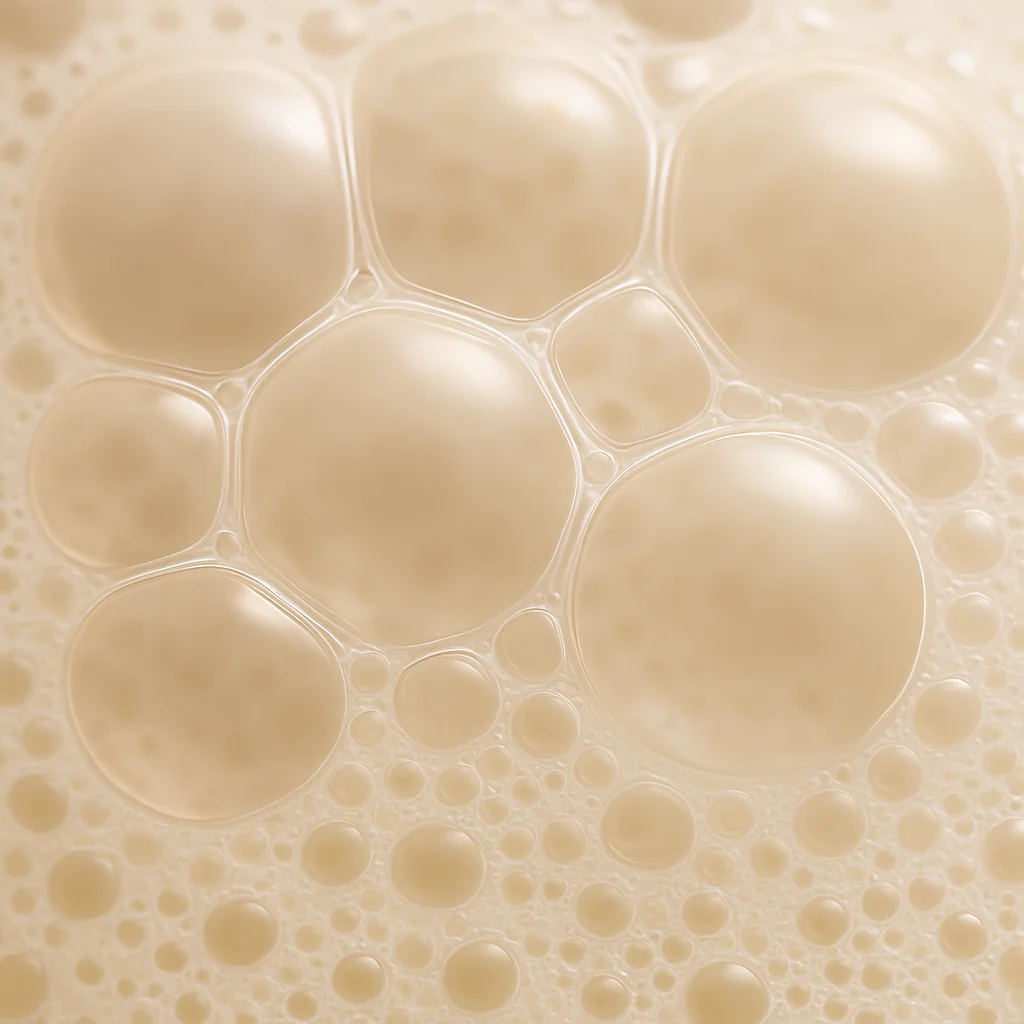
Not all foam is created equal, and the critical variable is bubble diameter. Coarse foam — the stiff, meringue-like froth that sits atop poorly steamed milk — consists of bubbles typically exceeding 500 micrometers in diameter. Microfoam, the tight-grained textile that latte art demands, is composed of bubbles generally smaller than 100 micrometers, often closer to 20–50 micrometers. At this scale, the foam takes on an almost paint-like consistency: glossy, pourable, and cohesive. The milk should look like wet white paint pooling on porcelain.
Achieving a uniform distribution of small bubbles is the purpose of the two-phase steaming technique described on the Steaming Technique page. The initial stretching phase introduces air near the surface, creating larger bubbles, while the subsequent polishing phase uses the vortex within the pitcher to shear those larger bubbles into progressively smaller ones. The physics here follow a principle called Kolmogorov’s theory of turbulence: the energy of the vortex cascades from large-scale flow patterns down to smaller and smaller eddies, and it is these micro-eddies that break bubbles apart.
Drainage, Coarsening, and Decay
From the moment steaming stops, three forces conspire to destroy your foam. The first is gravity-driven drainage: liquid in the lamellae flows downward, thinning the bubble walls until they rupture. The second is Ostwald ripening, a thermodynamic inevitability in which gas diffuses from smaller bubbles (which have higher internal pressure, per the Young-Laplace equation) into larger ones, causing small bubbles to shrink and vanish while large bubbles grow. The result is a progressive coarsening of the foam’s grain over time. The third is coalescence, in which thinned lamellae between adjacent bubbles simply break, merging two bubbles into one.
The practical consequence is that microfoam has a limited working window — typically 15 to 30 seconds of optimal texture after steaming. Swirling the pitcher maintains some integration, but physics is unforgiving. Fat content slows drainage slightly by increasing viscosity, and a well-developed protein film resists coalescence longer, but no foam is immortal.
The physics of foam is, in the end, the physics of impermanence — every microfoam you create is already in the process of unraveling. The craft lies in understanding that window of perfection and working within it. For guidance on reading your foam’s quality in real time, the Microfoam Fundamentals page offers a detailed visual and tactile framework, while the Troubleshooting page addresses specific symptoms of foam gone wrong.